

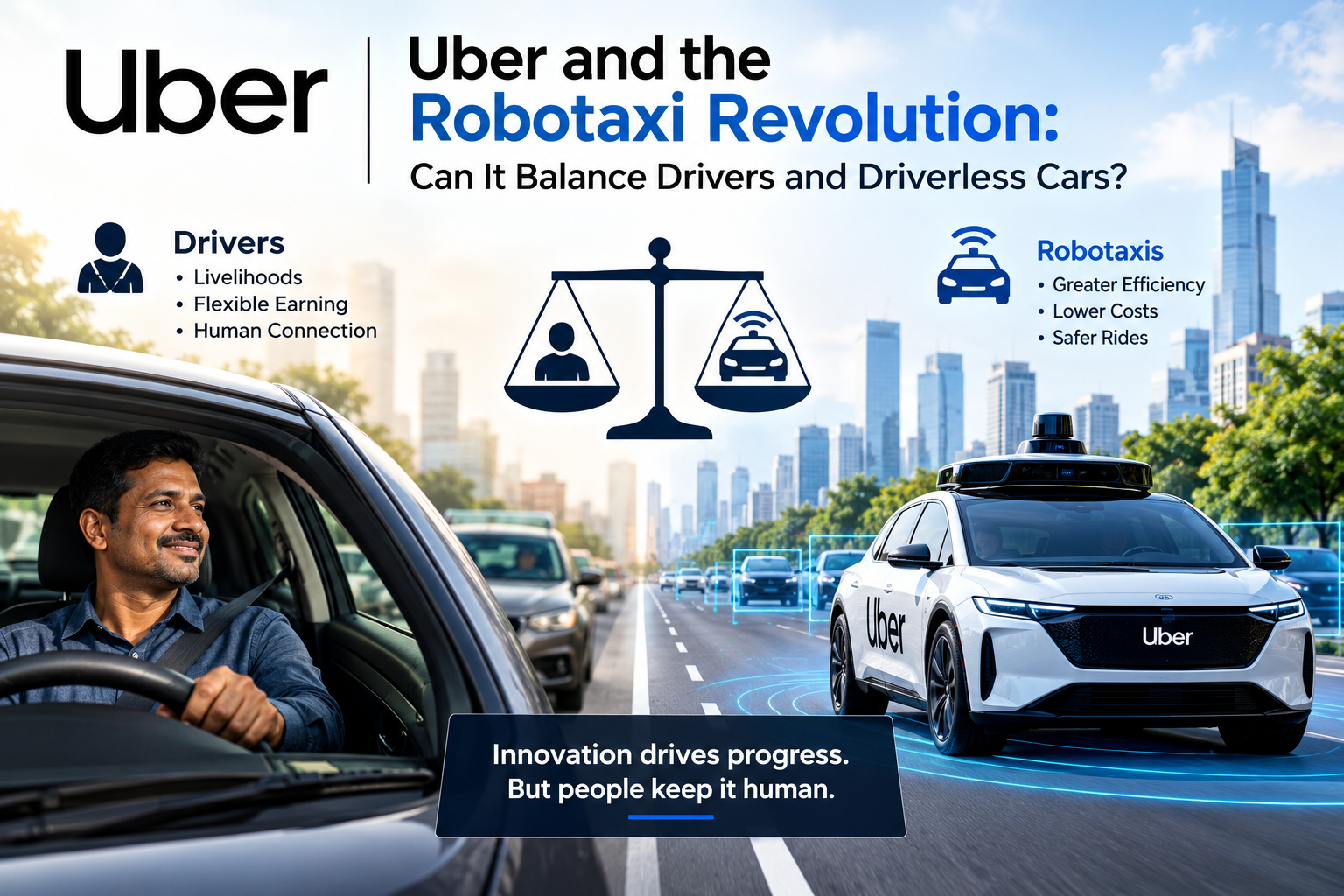
The rise of robotaxis is forcing Uber to rethink the future of ride-hailing. As self-driving technology moves closer to mainstream use, the company faces an unusual challenge: the same technology that could create new opportunities for Uber could also disrupt the driver-based business that made it a global transportation giant.
The rise of robotaxis is forcing Uber to rethink the future of ride-hailing. As self-driving technology
moves closer to mainstream use, the company faces an unusual challenge: the same technology that
could create new opportunities for Uber could also disrupt the driver-based business that made it a
global transportation giant.
Uber has built its business around connecting passengers with millions of drivers. But autonomous
vehicles are changing that equation. Companies such as Waymo, Zeekr are expanding driverless ride
services, creating a new competitive front in the global transportation industry.
For Uber, the question is no longer whether autonomous vehicles will become part of the ride-
hailing market. The bigger question is how the company can adopt robotaxis without putting its
existing business model at risk.
Robotaxis Are Challenging Uber’s Traditional Business Model
Uber's success has largely depended on its extensive network of drivers and customers. The more
drivers available on the platform, the easier it is for passengers to find a ride, while drivers benefit
from access to a large customer base.
Autonomous vehicles could change that model. A robotaxi does not require a human driver behind
the wheel. Once a self-driving fleet is operating at scale, companies can potentially provide rides
without depending on individual drivers for every journey.
This creates a direct challenge for Uber. Its network of millions of drivers has long been one of its
biggest strengths, but autonomous vehicles could reduce the importance of that network over time.
At the same time, Uber cannot afford to ignore the technology. If competing companies successfully
build large robotaxi networks, they could attract passengers without relying on Uber's platform.
Uber Is Betting on a Mix of Drivers and Robotaxis
Rather than choosing between human drivers and autonomous vehicles, Uber is pushing for a model
that brings both into the same transportation network. The company has highlighted situations
where human drivers can still provide an important service. Passengers who need additional
assistance may prefer a human driver, while difficult weather conditions or unusual road situations
could also make human-operated vehicles more practical.
This hybrid approach could allow Uber to introduce autonomous rides while keeping human drivers
as an important part of its platform. But there is also a clear business reason behind the strategy.
Uber has a strong interest in making sure robotaxis do not simply create a new transportation
network controlled by rival technology companies. Keeping autonomous vehicles within its broader
platform could allow Uber to benefit from the technology without giving up its relationship with
passengers.
The Robotaxi Battle Is Also a Regulatory Battle
The competition around self-driving cars is increasingly moving beyond technology. Government
regulations could have a major influence on how quickly robotaxis are deployed and how large their
fleets can become. Safety standards, licensing requirements and rules governing autonomous
vehicles could determine which companies are able to scale their services. This has created an
unusual situation for Uber.
The company's position can look different from one market to another because the competitive and
regulatory environments are different. In the United States, where autonomous ride-hailing
companies are becoming increasingly competitive, Uber has supported a greater role for human
drivers and has called for a balanced approach to robotaxi deployment.
In the UK, however, Uber has also moved into commercial autonomous ride services. That difference
highlights the challenge facing a global company operating across multiple markets. A strategy that
makes commercial sense in one country may create criticism in another.
What Does the Robotaxi Boom Mean for Uber Drivers?
The biggest concern surrounding autonomous ride-hailing may ultimately be its impact on drivers.
Millions of people around the world earn income through driving and delivery platforms. If robotaxis
become significantly cheaper and more widely available, demand for human drivers could eventually
decline in some parts of the market. However, the transition is unlikely to happen all at once.
Human drivers could continue to play an important role in areas where autonomous vehicles are
difficult to operate, as well as for passengers who require personal assistance. Cities with
complicated roads, challenging weather or restrictive regulations could also take longer to adopt
fully autonomous transportation. The real impact on drivers will depend on how quickly robotaxis
scale and how governments respond to the technology.
Uber Has to Protect Its Position in the Autonomous Vehicle Market
FOR UBER, ROBOTAXIS REPRESENT BOTH A MAJOR OPPORTUNITY AND A POTENTIAL THREAT.
Autonomous vehicles could help the company expand its ride network and reduce some of the
challenges associated with driver availability. But if technology companies build their own
transportation platforms and connect directly with passengers, Uber could find itself competing
against companies that have a fundamentally different cost structure.
That makes the autonomous vehicle transition particularly important for Uber. The company needs
to remain relevant as transportation technology changes while protecting the network and customer
relationships it has spent years building.
The Future of Ride-Hailing May Not Be Fully Driverless
Despite the rapid development of autonomous driving technology, the future of transportation is
unlikely to be completely human-driven or completely autonomous in the near term. A combination
of human drivers and robotaxis may become the more practical model.
For Uber, that could mean evolving from a platform primarily connecting passengers with drivers
into a broader mobility platform that manages different types of transportation. The success of that
strategy will depend on how effectively Uber can balance technology, regulation, customer
expectations and the interests of its driver network.
The robotaxi revolution is therefore about more than self-driving cars. It could change the
economics of ride-hailing, reshape the role of drivers and redefine how transportation companies
compete. For Uber, the challenge is making sure it remains at the center of that transformation
rather than becoming a casualty of it.
Business Insights
The rise of robotaxis could significantly change Uber’s business model. While autonomous vehicles
may improve efficiency and create new growth opportunities, they could also reduce the company’s
reliance on human drivers. Finding the right balance between traditional ride-hailing and
autonomous transportation will be key to Uber’s future. As the robotaxi market grows, factors such
as regulation, customer trust and the impact on drivers will shape how quickly self-driving cars
become mainstream. For Uber and other mobility companies, staying competitive will depend on
how effectively they adapt to the changing transportation industry.