

Introduction
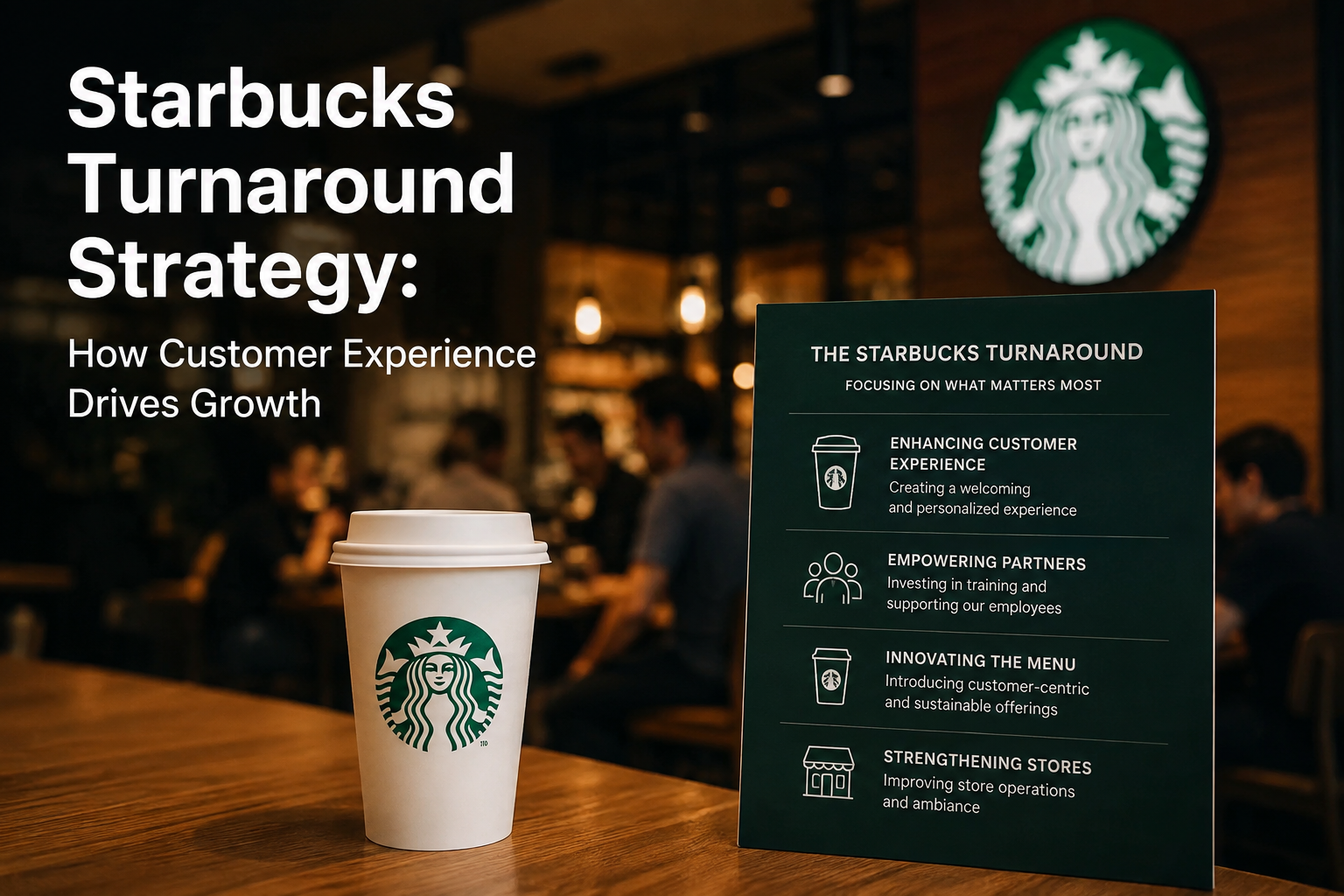
Brian Niccol joined the Starbucks organization as CEO at a time when one of the world’s best-known coffee brands was facing some tough challenges. Consumers were beginning to grumble about extended wait times and crowding in the shops, coupled with a lack of community spirit.
Brian Niccol joined the Starbucks organization as CEO at a time when one of the world’s best-known
coffee brands was facing some tough challenges. Consumers were beginning to grumble about extended
wait times and crowding in the shops, coupled with a lack of community spirit. Meanwhile, the
employees felt the growing complexity of the operations was making their job harder. Instead of aiming
for an extensive overhaul of the company’s activities, Niccol chose the strategy of recreating the very
traits that used to make Starbucks stand out.
Why Customer Experience Was Important?
Before he started his job, Brian Niccol visited many Starbucks stores. He watched routines and spoke
with both customers and staff. From these visits, he learned that customers did not want a completely
new brand. They wanted the classic experience of Starbucks. Customers said that the store lacked
seating, friendly conversations with baristas, and a welcoming atmosphere that would keep them seated
longer and enjoying their coffee. Workers also mentioned that the rising operational demands gave
them time to talk to customers. Using these insights, Niccol created a turnaround plan that showed that
Customer Experience is as important as analysis.
The "Back to Starbucks" Approach:
According to Brian Niccol's "Back to Starbucks" approach, instead of trying to keep up with all
the trends in the industry, the company needs to concentrate on recovering its core identity. In
Niccol's opinion, the emphasis must be placed on coffee, craftsmanship, and strong
relationships with the company's customers. Thus, according to the new approach, the company
works on creating more inviting stores, offering better personalized service, streamlining its
operations, and making each visit pleasant for customers.
Baristas as the Core of the Starbucks Brand:
In interviews with Brian Niccol, a common idea was stated that baristas are the core of the
Starbucks brand. According to him employees need chances to develop good relations with
customers rather than do complex organizational work most of the time. Thus in order to
achieve his goal Starbucks has added staff at some branches made some processes easier, for
workers and has implemented other changes aimed to help baristas concentrate on hospitality.
It is true that people not remember what coffee baristas serve but also how it is served.
Better Customer Service but Maintaining the Personal Touch:
As fast as the service at Starbucks may be, Brian Niccol is of the view that efficiency cannot
come at the expense of hospitality. Starbucks has introduced efficient coffee machines to
ensure faster drink preparation, improved staff numbers when there are many customers, and
efficient processing of orders inside the store as well as in drive-through lines. All this is
intended to minimize the time customers have to wait without compromising the personal
touch.
How AI Helps without Replacing the Employees?
According to Brian Niccol, the application of artificial intelligence is not supposed to be used to replace
but support the employees. The new technologies being incorporated by Starbucks are those involving
artificial intelligence, which will be helpful for the purpose of order entry and troubleshooting of
machines. This makes the employee to spend most of the time interacting with the customers instead of
dealing with other issues. According to Niccol, there should be no need for complete automation since
technology will only enhance the human touch at Starbucks.
Streamlining Processes to Enhance Experience:
Another key takeaway for Niccol from the staff was the fact that a lot of processes had become
overly complicated. In an effort to alleviate pressure off the baristas and improve productivity,
Starbucks has been able to streamline some elements of their menu, streamline processes,
enhance scheduling, and eliminate friction in processes that have been slowing down service
delivery.
The Results Are Already Showing Up:
There have already been early indicators that the customer-based approach of Brian Niccol has
started yielding favorable results for him. It seems that the performance of Starbucks has shown
improvements in terms of sales and service efficiency along with an increase in the number of
customers and improved business outlook. Even though the transformation is still going on,
these improvements are certainly encouraging.
Remaining Challenges:
However, in spite of all this optimistic progress, there still remain a number of serious challenges
for the corporation to overcome. Disruptions in the supply chain, proper inventory control,
adapting to customers' preferences, and providing fast yet hospitable services will keep on being
a priority for the company. It will be a challenge to keep the uniformity of experience in
thousands of Starbucks around the world.
Key Takeaways
The leadership exhibited by Brian Niccol carries many lessons not just for companies in the coffee sector
but for businesses in general. This leader's approach has shown that sometimes, a better solution than
chasing new trends would be to reestablish the essential identity of a business. Through investment in
their people, process simplification, AI usage, faster service, and enhanced customer relations, Starbucks
is seeking growth through building trust.
Conclusion
In Brian Niccol’s tenure at Starbucks, it becomes evident that not all successful business turnarounds
must hinge on innovative approaches. On the contrary, in his leadership style, he highlights how crucial
it is to go back to the basics of a particular brand, such as great coffee, people connections, and good
customer experience. Having streamlined operations, worked on the baristas, used AI effectively, and
gone back to the coffeehouse culture that the customers like, Starbucks will definitely regain its
customers’ trust and create more loyalty to its brand.